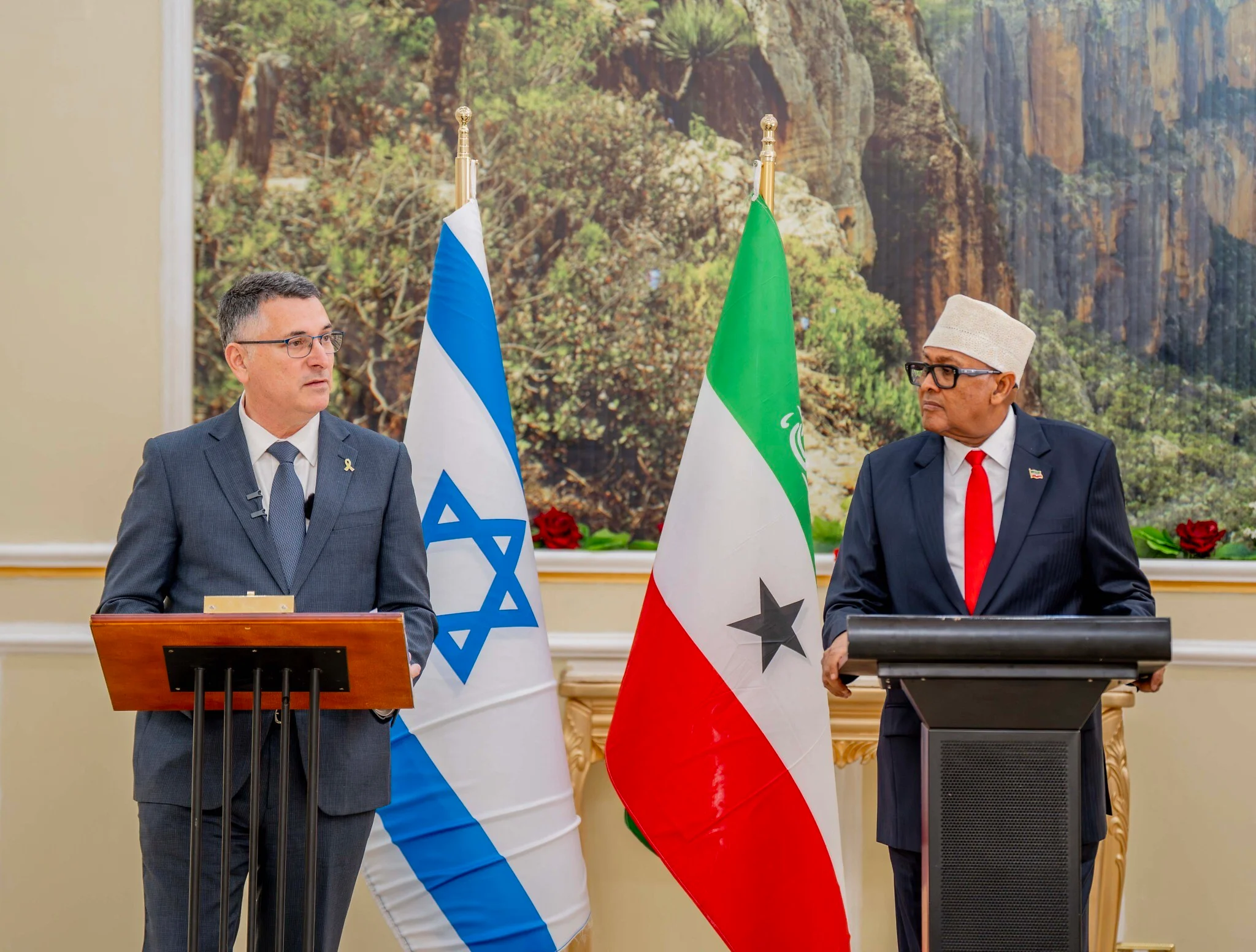
 This handout photograph taken and released by the Somaliland Presidential Office on January 6, 2026, shows Somaliland’s President Abdirahman Abdullahi Mohamed (right) speaking during a press conference with Foreign Minister Gideon Sa’ar at the Presidential Palace in Hargeisa. (Somaliland Presidential Office / AFP)
SomaliComment | Latest News
The question of whether Israel should recognise Somaliland as an independent state has sparked debate and controversy across Somalia, the Horn of Africa, and the wider international community.
While Somaliland has operated as a self-declared state since 1991, any potential recognition by Israel would carry significant political, legal, and regional implications.
Background: Somaliland’s Status
Somaliland declared independence from Somalia in 1991 following the collapse of the central government.
Since then, it has maintained its own government, security forces, currency, and elections. However, no United Nations member state has formally recognised Somaliland as an independent country.
Internationally, Somaliland is still considered part of the Federal Republic of Somalia, whose territorial integrity is recognised by the UN, African Union (AU), and Arab League.
Why Israel’s Recognition Would Be Controversial
1. Violation of Somalia’s Territorial Integrity
Somalia’s federal government strongly opposes any unilateral recognition of Somaliland, viewing it as a breach of sovereignty.
If Israel were to recognise Somaliland, Somalia would likely see this as interference in its internal affairs and a violation of international law principles respecting existing borders.
2. African Union Position
The African Union has consistently supported Somalia’s unity, fearing that recognition of breakaway regions could set a precedent for separatist movements across Africa. Israel’s recognition would directly contradict the AU’s long-standing position.
3. Regional Security Concerns
The Horn of Africa is already a sensitive geopolitical region involving Ethiopia, Djibouti, Eritrea, the Red Sea, and Gulf states.
Any move by Israel could heighten tensions, particularly if it is perceived as part of broader strategic competition over ports, military access, or Red Sea security.
4. Middle East and Arab World Reactions
Somalia is a member of the Arab League and has historically supported Palestinian rights.
Israel recognising Somaliland could strain Israel’s relations with Arab and Muslim-majority countries, especially if Somalia formally protests or downgrades diplomatic ties.
5. Legal and Diplomatic Precedent
Recognition of Somaliland by Israel could encourage other states to act independently of international consensus, weakening established diplomatic norms around state recognition and post-colonial borders.
Why the Issue Is Being Discussed
Supporters of recognition argue that Somaliland has demonstrated relative stability, democratic processes, and effective governance compared to southern Somalia.
Some analysts also speculate that Israel may be interested in strategic partnerships along the Red Sea and Gulf of Aden, though no official policy has been announced.
Somalia’s Official Position
The Somali federal government has repeatedly stated that any recognition of Somaliland without Somalia’s consent is unacceptable.
Mogadishu insists that the future of Somaliland must be resolved through dialogue within a united Somali state.
Conclusion
While Somaliland continues to seek international recognition, Israel’s potential recognition would be highly controversial due to its implications for Somalia’s sovereignty, African unity, regional stability, and international law. For now, the issue remains speculative, but it highlights the fragile balance of politics in the Horn of Africa.
Author: Ibrahin Muse
Role: SomaliComment Reporter
Based in: South Africa
Disclaimer / Editorial Notice:
This article is published in good faith for historical and informational purposes only.
All names, dates, and references are based on publicly available information.
No harm or misrepresentation is intended.
If any part of this content is found to be inaccurate, incomplete, or disputed, please contact us and we will review the matter and make corrections where appropriate.
If any part of this article is found to be inaccurate, incomplete, or subject to dispute, please contact us so we can review the matter and make any necessary corrections.